


Introduction
In part 1 of this series I identified a troubling signal in U.S. infant mortality, but was not able to explain this signal through maternal or infant COVID vaccinations.
To shed some light on the matter, we will be taking a brief look into the top-gainers among the causes of infant deaths.
This article may be very upsetting to some readers, so if you’re having a bad day, do yourself a favor and read something else.
This is just so much worse than I had ever imagined.
Methods
I used CDC Wonder to download annual infant deaths occurring in the years 2015 through 2022, both by UCOD (Underlying Cause Of Death) and MCOD (Multiple Causes Of Death). Data for these 8 years was available for…
394 causes of death by UCOD
713 causes of death by MCOD
There are countless options to isolate signals, but this is the method I decided to use:
Determine the standard deviation for each time series
Determine by how many standard deviations 2022 deviates from the 2015-2022 mean
Sort in descending order
Downloads
You can download all annual time series for all diagnostic keys.
Since most of the signals are hidden when looking only at the UCOD’s I will limit the analysis to signals by MCOD.
Results: Select signals by MCOD
Before discussing the results, here is a visual representation of the 36 top signals, followed by a table listing the top 60 signals.

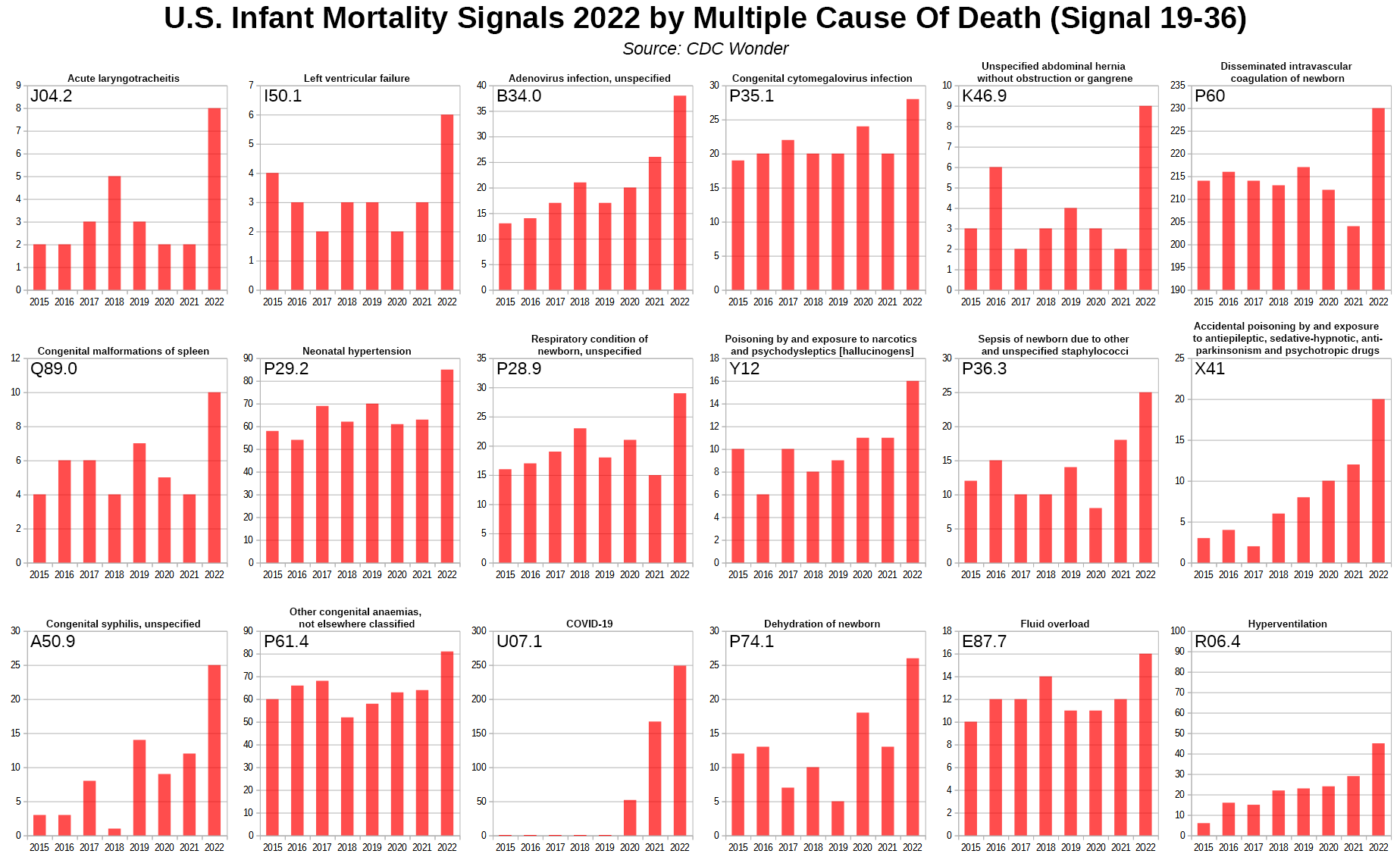

“σ (2022)” describes how far the year 2022 deviates from the 7 preceding years. It represents a very basic measure of signal strength.
“2022-2021” is simply the increase in the number of deaths with the respective ICD-10 code on the death certificate from 2021 to 2022.
I will now give you a brief overview of the signals I consider important.
Summary of safety signals
Some symptoms belong into multiple categories, so there is some overlap. When I mention “excess deaths/cases” I am referring to the increase from 2021 to 2022.
Signals related to the immune system
We’ve got quite a few signals for viral infections. Coronaviral infections unsurprisingly lead the list, but enteroviral, adenoviral, cytomegaloviral, herpesviral, RSV and influenza infections were also increased in 2022. It’s a long list which clearly indicates an issue with innate immunity.
Bacterial infections are most often secondary to viral infections, but they also occur isolated, particularly in immunocompromised patients. Since they are often not differentiated for coding purposes, all we’ve got here is pseudomonas and staphylococcus infections on top of unspecified bacterial sepses and congenital syphilis.
Bacterial sepses represent the largest of these signals, with an excess of 171 deaths compared to 2021.
The diagnostic code D81.9 deserves some attention. It is relatively uncommon for newborns to be diagnosed with “combined immunodeficiency”. The annual incidence increased from 4-5 cases between 2018 and 2021 to 11 cases in 2022.
Malformations
There are a signals for malformations of the spleen, circulatory system and limbs. None of these make up a very large proportion of death. Situs inversus (organs located on the wrong side of the body) was diagnosed 33 times in infant deaths throughout 2022, but only 21 times in 2020 and 2021 and tetralogy of Fallot (a complex cardiac malformation) saw an uptick of 31 deaths as well. Deaths involving open ductus arteriosus increased by 41 from 2021 to 2022.
Cardiovascular signals
The major signals here are:
118 excess cases of cardiac dysrhythmias
83 excess cases of cardiac failure.
31 excess cases of tetralogy of Fallot
20 excess cases of acquired cardiac septal defects
Cerebrovascular signals
100 excess cases of nontraumatic intraventricular haemorrhage (grade 3)
Accidental / external / psychosocial
Compared to 2021 we’ve got 108 more deaths where asphyxiation was mentioned on the death certificate, 76 accidental suffocations and strangulations in bed, and 34 hangings, strangulations and suffocations of undetermined intent.
It is hard to tell how many of these were assaults, how many were related to other health issues and how many represent actual accidents. Don’t expect these figures to be accurate.
Inhalation of gastric content is likely secondary to other disorders and increased from 7-11 cases between 2015 and 2021 to 17 cases in 2022.
Blood disorders
There are some extremely strong signals here, that should be cause for immediate government investigation into the matter.
Transient neonatal thrombocytopenia: 45 extra deaths, an increase by 900%
Primary thrombophilia: 17 extra deaths, up from 3-4 between 2019 and 2021
Disseminated intravascular coagulation of newborn: There were 230 cases in 2022, up from a very stable 204-216 cases throughout the previous 7 years.
Perinatal (P* codes)
There is a very long list of signals representing disorders originating in the perinatal period. Some of these were frighteningly common, others saw large increases despite still being relatively rare overall.
Since I have already shown you charts for many of the less common disorders, I will just list the ones with the largest absolute increase from 2021 to 2022 here, all of which are also above the 2015-2022 mean.
+333 deaths: P28.0 (Primary atelectasis of newborn)
+171 deaths: P36.9 (Bacterial sepsis of newborn, unspecified)
+168 deaths: P96.8 (Other specified conditions originating in the perinatal period)
+118 deaths: P29.1 (Neonatal cardiac dysrhythmia)
+106 deaths: P20.9 (Intrauterine hypoxia, unspecified)
+100 deaths: P52.2 (Intraventricular (nontraumatic) haemorrhage, grade 3, of newborn)
+97 deaths: P96.0 (Congenital renal failure)
+83 deaths: P29.0 (Neonatal cardiac failure)
+76 deaths: P03.9 (Newborn affected by complication of labour and delivery, unspecified)
+57 deaths: P77 (Necrotizing enterocolitis of newborn)
+53 deaths: P29.3 (Persistent fetal circulation)
+52 deaths: P03.8 (Newborn affected by other specified complications of labour and delivery)
+48 deaths: P27.1 (Bronchopulmonary dysplasia originating in the perinatal period)
+47 deaths: P91.6 (Hypoxic ischemic encephalopathy of newborn)
+45 deaths: P61.0 (Transient neonatal thrombocytopenia)
+43 deaths: P22.0 (Respiratory distress syndrome of newborn)
+42 deaths: P28.5 (Respiratory failure of newborn)
+37 deaths: P01.2 (Newborn affected by oligohydramnios)
+35 deaths: P01.7 (Newborn affected by malpresentation before labour)
+30 deaths: P54.9 (Neonatal haemorrhage, unspecified)
+26 deaths: P60 (Disseminated intravascular coagulation of newborn)
+26 deaths: P78.0 (Perinatal intestinal perforation)
+26 deaths: P22.9 (Respiratory distress of newborn, unspecified)
The strongest signal here are primary atelectases. Atelectase describes a condition in which part of the lung closes or collapses, limiting gas exchange. Think of pulmonary alveoli with very low volume, where the walls almost touch each other.
The most common cause for atelectases in the neonatal period are
respiratory distress syndrome
bacterial pneumonia
meconium aspiration syndrome
bronchopulmonary dysplasia
pleural effusion
pneumothorax
Mechanical ventilation often exacerbates the condition.
It is not unlikely that a large share of excess deaths involving atelectases were related to infections and mechanical ventilation. In any case the signal warrants further investigation.